


Learn It Properly. Build It Honestly.
Quantzivo connects education, strategy development and market research, with a consistent commitment to practical skills, stated assumptions and realistic expectations about risk.
Quantzivo connects education, strategy development and market research, with a consistent commitment to practical skills, stated assumptions and realistic expectations about risk.
Not slogans, but choices that shape every course, tool and page.

Learning, building and research share one set of concepts, so nothing gets lost between steps.
How it connects

You learn by writing Python against historical market data, not by watching slides.

Costs, drawdowns, overfitting and failed strategies are part of the curriculum from the start.

Every illustrative result is shown with the costs, fills and data choices behind it.

Quantzivo AI is designed to explain and cite sources, not to predict prices or give advice.
AI assistant
Clear starting points for students, developers, traders, researchers and professionals.

Structured programs for colleges and companies, scoped to their goals.
College programs
We say plainly what is available, what is in development and what is still planned.
Many learners assemble their own toolkit from unrelated courses, libraries and websites. That can work, but it comes with friction.
| Aspect | Piecing tools together | One connected ecosystem |
|---|---|---|
| Learning path | You decide the order yourself and often discover gaps late | Sequenced courses and learning paths with clear prerequisites |
| Concepts and vocabulary | Each source defines metrics and terms its own way | Metrics and terms defined once and used consistently |
| From theory to code | Theory courses rarely connect to the code you later write | Lessons built around coding projects on historical data |
| Testing ideas | Assumptions about costs and fills vary by tool and are easy to miss | Designed to keep costs, slippage and fill rules visible with results |
| Market research | Separate sites for charts, filings, news and macro data | Planned single workspace for technical, fundamental, news, sentiment and macro research |
| Risk education | Often an afterthought, or missing entirely | Built into every stage, from first lesson to backtest review |
| Context switching | Exporting, reformatting and re-learning between tools | Designed so skills and work move between platforms |

This comparison describes two general approaches, not specific products. Quantzivo Studio and Quantzivo AI are in development, so the ecosystem column reflects planned design that may change before release.
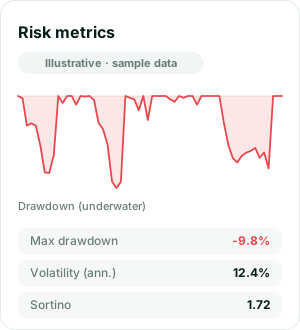

A strategy that looks good before costs can look very different after them. We teach you to account for that in the code itself, so it is never forgotten.
# Illustrative: deduct trading costs before judging a strategy
position = signal.shift(1) # act on the next bar, not the same one
gross = position * returns
turnover = position.diff().abs()
net = gross - turnover * cost_per_trade
print("Max drawdown:", max_drawdown(net)) Avoid look-ahead bias by trading on the next barCharge costs on every change in positionJudge risk alongside return, never return alone
These are the design principles for Quantzivo AI, which is currently in development.

Summaries and explanations help you understand data. Decisions stay with you.

News and research summaries are designed to link back to the original material.

Where data is limited or mixed, the goal is to say so rather than sound confident.
Calculations and comparisons are designed to be inspectable, not hidden behind a score.
In development
Knowing what a platform will not do matters as much as knowing what it will.

We do not tell you which stocks, contracts or coins to trade.

No course, tool or plan can promise profits, and we never claim otherwise.

We do not publish signals, alerts or calls to act on.

AI features summarize and explain data. They do not forecast prices.

Paper trading is simulated only. Quantzivo does not place real orders.

Sample results are labeled illustrative, and we do not publish invented testimonials or statistics.
Risk warning: Trading and investing involve risk, including the loss of capital. Backtested and simulated results do not reflect real trading and do not guarantee future performance. Read the Risk Disclaimer.
The same practical, risk-aware approach, shaped around the goals of a college or a company.
Bring hands-on quantitative finance, Python and trading-technology learning to students alongside their degree.
Upskill analysts, engineers and finance teams in Python, financial data analysis, backtesting and responsible use of AI.
Browse the Academy curriculum, or request a walkthrough of the planned Studio and AI workflows for yourself, your campus or your team.