


Explore 50 Courses Across Ten Disciplines
From market fundamentals and Python to algorithmic trading, quantitative research, AI and FinTech engineering. Filter by discipline and find your next course.
From market fundamentals and Python to algorithmic trading, quantitative research, AI and FinTech engineering. Filter by discipline and find your next course.

 3 weeks
 3 modules
A structured introduction to how global equity, fixed income, currency and commodity markets are organized, who participates, and how prices and risk are communicated.

 4 weeks4 modules
Learn how price charts, volume and market microstructure are read and measured, and how to test chart-based ideas critically instead of taking patterns on faith.
 5 weeks5 modules
Read financial statements, build a structured company model and value a business with multiples and discounted cash flow, while documenting every assumption.
 4 weeks4 modules
Learn to identify, measure and communicate market, credit, liquidity and operational risk using volatility, drawdown, VaR and stress testing concepts.
 5 weeks5 modules
Analyze multi-asset portfolios across global markets with return attribution, risk decomposition, currency effects and optimization methods, all in Python.
 5 weeks5 modules
Learn Python from the ground up through financial examples: core syntax, pandas time series, returns calculations, plotting and clean, testable code.
 6 weeks6 modules
Write fast, well-structured and well-tested Python for quantitative work: performance profiling, vectorization, concurrency, typing, packaging and design patterns.
 5 weeks5 modules
Turn raw market and fundamental data into reliable insights with pandas, statistics and visualization, emphasizing data quality, reproducibility and honest interpretation.
 6 weeks6 modules
Build dependable data collection and storage for financial applications: consuming REST and WebSocket APIs, validating data, and orchestrating pipelines into PostgreSQL.
 7 weeks7 modules
Design and build interactive financial dashboards and small web applications with Python, from data layer and charts to authentication, testing and deployment.
 4 weeks4 modules
Learn how algorithmic trading systems are structured, from market data and signals to orders, risk checks and evaluation, with a clear view of their limits.
 6 weeks6 modules
Build a modular algorithmic trading research stack in Python, covering data handling, signal libraries, vectorized and event-based backtests, and paper-trading workflows.
 8 weeks8 modules
Develop multi-signal, multi-asset algorithmic strategies with rigorous research workflows, realistic execution modeling and disciplined robustness testing.
 8 weeks8 modules
Design and build an event-driven trading system architecture with message queues, state management, risk services and replayable simulations shared between research and paper trading.
 10 weeks10 modules
Engineer a professional-grade algorithmic research platform with versioned data, experiment tracking, scalable backtesting, validation gates and review workflows.
 5 weeks5 modules
Learn a structured process for designing trading strategies: forming hypotheses, defining rules, choosing data and evaluation criteria, and documenting research honestly.
 6 weeks6 modules
Build accurate, bias-aware backtesting engines in Python, from vectorized prototypes to event-driven simulators with realistic costs, fills and portfolio accounting.
 7 weeks7 modules
Apply rigorous validation methods to trading strategies: walk-forward and cross-validation, overfitting diagnostics, multiple testing control and robust parameter optimization.
 8 weeks8 modules
Combine strategies into portfolios and analyze their risk with allocation methods, risk decomposition, drawdown analysis, stress testing and risk reporting in Python.
 10 weeks10 modules
Practice quant research the way professional teams structure it: rigorous hypotheses, point-in-time data, factor-aware testing, validation, peer review and decision memos.
 4 weeks4 modules
A practical introduction to how AI and machine learning are applied to financial data, with an emphasis on sound evaluation, data leakage and the limits of prediction.
 7 weeks7 modules
Apply supervised and unsupervised machine learning to financial datasets using feature engineering, purged cross-validation and disciplined, leakage-aware evaluation.
 8 weeks8 modules
Build and evaluate deep learning models for financial time series in PyTorch, from recurrent networks to temporal convolutions and transformers, with rigorous validation.
 7 weeks7 modules
Turn financial news, filings and transcripts into structured research signals using text processing, embeddings, transformer models and careful event-time alignment.
 10 weeks10 modules
Engineer LLM-based research agents that retrieve documents, call analytical tools and produce traceable financial research outputs with evaluation and guardrails built in.
 6 weeks6 modules
Build the core mathematics behind quantitative finance, including calculus, linear algebra, optimization and an introduction to stochastic processes, with Python exercises.
 6 weeks6 modules
Learn the probability and statistics used in quantitative research, from distributions and estimation to hypothesis testing, regression and resampling, applied to market data.
 8 weeks8 modules
Model financial time series with stationarity tests, ARIMA, GARCH, cointegration and state-space methods, and evaluate forecasts with disciplined out-of-sample testing.
 8 weeks8 modules
Research, construct and evaluate factor models using cross-sectional regressions, portfolio sorts and risk attribution, with careful handling of biases and multiple testing.
 10 weeks10 modules
Build professional portfolio models covering covariance estimation, robust optimization, risk budgeting, transaction costs and stress testing, implemented as tested Python code.
 4 weeks4 modules
Learn how futures, forwards, options and swaps work, how they are priced at a basic level, and how their payoffs and risks differ across global markets.
 6 weeks6 modules
Implement binomial trees, Black-Scholes-Merton and Monte Carlo option pricers in Python, then test them against each other and against known analytical results.
 6 weeks6 modules
Compute, interpret and aggregate option Greeks in Python, and use scenario analysis and stress testing to understand how options portfolios respond to market moves.
 8 weeks8 modules
Model realized and implied volatility with GARCH, stochastic and local volatility approaches, build arbitrage-aware volatility surfaces, and run disciplined derivatives research.
 10 weeks10 modules
Design and build production-grade options analytics software: a pricing and risk library, surface services, APIs, persistence, testing and a web front end.
 5 weeks5 modules
Learn the foundations of financial data engineering: data types, schemas, SQL, ingestion, cleaning, corporate actions and reliable batch pipelines in Python.
 7 weeks7 modules
Build batch and streaming market data pipelines in Python with Kafka, PostgreSQL and Parquet, covering normalization, bar aggregation, quality checks and replay.
 7 weeks7 modules
Engineer pipelines that collect, clean, deduplicate, tag and score financial news and text data, producing point-in-time sentiment datasets suitable for research.
 8 weeks8 modules
Build a macroeconomic data platform that ingests public economic series, tracks vintages and releases, computes indicators and serves dashboards and APIs.
 10 weeks10 modules
Study and build low-latency market data systems: feed handlers, order book reconstruction, efficient serialization, lock-free design, measurement and resilient distribution.
 5 weeks5 modules
Learn the engineering habits behind dependable financial software: precise money handling, clean Python projects, testing, version control and CI pipelines.
 8 weeks8 modules
Build full-stack financial web apps with a FastAPI backend and a React and TypeScript frontend, from charts and tables to live data updates and deployment.
 8 weeks8 modules
Design reliable financial backends: ledger data models, idempotent APIs, event-driven processing with Kafka, security, observability and audit trails.
 9 weeks9 modules
Run financial workloads in the cloud with containers, Kubernetes, infrastructure as code, secure networking, observability and tested disaster recovery plans.
 12 weeks12 modules
Design, build and operate a multi-tenant SaaS for AI-assisted financial research, with document retrieval, cited answers, evaluation, billing and secure deployment.
 10 weeks10 modules
A professional track for quant developers: fast Python, market data structures, backtesting engine design, research infrastructure and production-ready simulated execution.
 10 weeks10 modules
Engineer large-scale financial data systems with point-in-time correctness, bitemporal storage, streaming pipelines, data quality controls and governed access.
 10 weeks10 modules
Architect AI research agents for finance: tool use, memory, planning, grounded retrieval, evaluation, guardrails and production deployment with full audit logs.
 12 weeks12 modules
Complete an end-to-end quantitative research project on historical data, from hypothesis and backtest to robustness testing, peer review and a reproducible write-up.
 12 weeks12 modules
Master end-to-end fintech architecture: ledgers, event sourcing, integrations, security, reliability, scalability, compliance-aware design and AI components.

Proposed launch pricing. Fees and durations shown are planning figures in USD and are not yet confirmed commercial offers. Final pricing, schedules and terms are confirmed before any payment is taken.
Structured, project-led tracks that combine several courses with live technical mentoring where included, code reviews and a capstone assessment.
 12 weeks7 modules
A 12-week program that takes you from Python market data work to building, backtesting, validating and engineering algorithmic strategies as tested software.
 16 weeks8 modules
A 16-week research program covering statistics, time-series models, machine learning, factor research and NLP, applied through rigorous validation on historical data.
 16 weeks8 modules
A 16-week engineering program for building financial platforms end to end: backend APIs, React frontends, data pipelines, cloud infrastructure and systems architecture.
 20-24 weeks8 modules
A 20-24 week program for leaders overseeing quant technology: research methodology, data strategy, AI adoption, systems architecture, controls and team building.
Every course sits in a tier that reflects its depth and delivery. Teams and institutions can also book enterprise training.
| Tier | Proposed price range (USD) | Delivery | Best for |
|---|---|---|---|
| Foundation courses | $149-$399 | Self-paced | Market and programming foundations |
| Specialist courses | $499-$999 | Applied technical skills | Hands-on Python, data, strategy and AI skills |
| Professional certificates | $1,499-$2,999 | Structured programs | Deep, project-led professional tracks |
| Elite bootcamps | $3,499-$5,999 | Live mentorship and projects | Flagship cohorts with mentoring and capstones |
Every course follows the same rhythm, so once you have taken one you know exactly how the next will run.

Short lessons that explain one concept at a time, with worked examples on historical market data.

Coding and analysis exercises in notebooks, many with automated checks so you get feedback quickly.

Each course includes projects such as data loaders, backtest reports and research memos that you keep.

Module quizzes and project reviews against clear rubrics confirm you can apply what you learned.

When a course runs as a cohort, live Q&A sessions, workshops and code reviews are added.

Finish the lessons and pass the assessed projects to earn a Quantzivo certificate of completion.
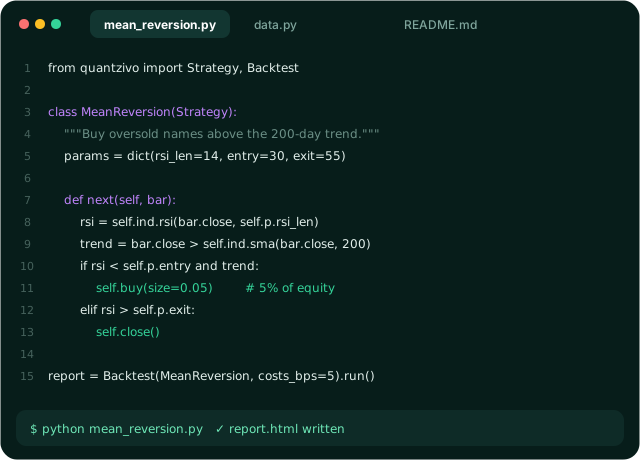

Courses teach the method behind a result, not just the result. You will see why a strategy looks good on paper, and why it often stops looking good once costs, slippage and out-of-sample data are included.
 Python, pandas and NumPy used throughoutTransaction costs, drawdowns and overfitting covered explicitlyProjects documented so you can explain your decisions
About certificates: Quantzivo certificates recognize course completion. They are not professional licenses, degrees or regulatory qualifications.
Or let a learning path sequence the courses for a specific goal.

Start with how instruments, order books and risk work before writing any code.
Global Financial Markets Fundamentals
Learn Python and pandas on the market data you already understand.
Python Programming for Financial Markets
Go straight to designing rule-based strategies and realistic backtests.
Algorithmic Trading with Python
Follow a structured path toward research, engineering or data roles.
See learning paths
Register your interest and tell us which courses you are considering. We will share formats, schedules and pricing as enrollment opens.