



Turn Trading Ideas into Explicit, Testable Rules
The Strategy Builder is designed to help you define entries, exits, parameters and risk controls visually, then send them straight to a backtest.
The Strategy Builder is designed to help you define entries, exits, parameters and risk controls visually, then send them straight to a backtest.
"Buy the dip in a strong market" sounds clear until you try to test it. What counts as a dip? How strong is strong? When do you sell? The Strategy Builder is designed to force those answers into precise, readable conditions.

Product status: Quantzivo Studio is in development. Features described here reflect the planned scope and may change before release.
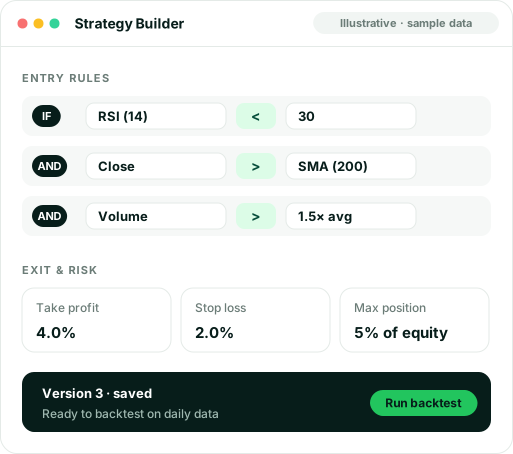


Combine conditions with AND / OR logic into a complete, deterministic strategy.

Define when to open, scale and close positions, including time-based exits.

Trend, momentum, volatility, volume and price-level conditions from common indicators.

Expose lookbacks and thresholds as named inputs for controlled sensitivity tests.

Stop losses, take profits, position limits and exposure caps attached to every strategy.

Every saved change becomes a version you can compare, annotate and roll back to.

Build and rearrange rule blocks visually, with a plain-language summary alongside.

Warnings for missing exits, conflicting conditions or indicators that need more history.
This is the kind of rule set the Strategy Builder is designed to express. It is a teaching example used to show structure, not a strategy we recommend or expect to be profitable.
| Component | Rule | What it means |
|---|---|---|
| Data | Daily bars, one instrument at a time | Each decision is made once per day using that day's completed bar. |
| Trend filter | Close > 200-day simple moving average | Only consider buying when price is above its long-term average. |
| Entry | RSI(14) < 30 AND trend filter is true | Buy after a short-term pullback, but only within a longer-term uptrend. |
| Fill timing | Next bar's open | The order is assumed to fill on the following open, never on the bar that triggered it. |
| Exit | RSI(14) > 55, or 10 bars in the trade | Sell once momentum recovers, or give up if it has not after two trading weeks. |
| Stop loss | 2% below entry price | Cap the loss on any single trade if the pullback keeps falling. |
| Position size | 5% of equity per trade | Limit how much any one trade can affect the portfolio. |

Oversold readings in a falling market can stay oversold. The filter tests whether pullbacks behave differently when the long-term trend is up.

Without one, a losing trade can sit open indefinitely. A time limit keeps capital from being tied up in an idea that is not working.

Gaps through the stop, costs, slippage and changing market regimes. A backtest has to model these before the result means anything.

Educational example only. This rule set illustrates how strategies are structured. It is not a recommendation to buy or sell any security, and no claim is made about how it would perform.

Note what you expect to happen and why, so the test has something to confirm or reject.

Choose indicators and thresholds for entries and exits, and set the data frequency.
Set stops, targets, position sizing and exposure limits before anything runs.

Save a version and send it to the Backtesting Engine with costs and slippage applied.
BacktestingCondition families are grouped by what they measure. Each can be combined with others and tuned through parameters.
Is price generally rising or falling over the window you care about?
How fast price has moved recently, and whether that move is stretched.
How much price typically moves, useful for filters and for sizing stops.
Whether a move is happening on unusually high or low trading activity.
Breakouts and pullbacks relative to recent highs, lows and ranges.
Rules tied to holding periods, sessions or days rather than price.
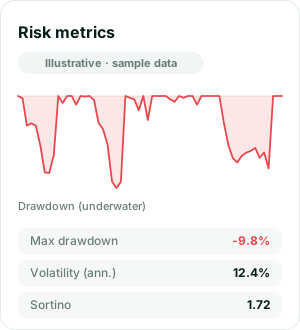
The Builder is designed so a strategy cannot be saved without an exit path. Parameters are kept separate from logic, which makes it easy to test sensitivity and harder to tune a rule until it fits the past perfectly.
 Stop-loss, take-profit and trailing-stop rulesPosition sizing as a share of equity or volatility-basedLimits on open positions and total exposureParameter ranges for sensitivity tests, with an overfitting reminder
Tweaking a rule after each disappointing backtest is one of the fastest routes to overfitting. Versioning is designed to make that process visible.
Each save captures rules, parameters and risk settings together.

See exactly which condition or threshold changed between two versions.

Record why you made a change before you see the new result.

Every backtest stays attached to the version that produced it.
Request a demo to hear about early previews and tell us which conditions and risk controls matter most to your research.
 Move to Python code
 Paper trading
 Algorithmic Trading with Python course