



Run Strategies Forward, Without Risking Real Money
Paper trading in Quantzivo Studio is designed to run your strategies on new market data in virtual portfolios, using simulated orders only.
Paper trading in Quantzivo Studio is designed to run your strategies on new market data in virtual portfolios, using simulated orders only.
A backtest only ever sees the past. Paper trading lets a strategy meet data it has never seen, in real time, so you can check whether its behavior still matches what the backtest suggested before drawing any conclusions.

Simulation only. Paper trading has no broker connection and uses no real money. Simulated fills are estimates and will differ from what would happen in live markets.
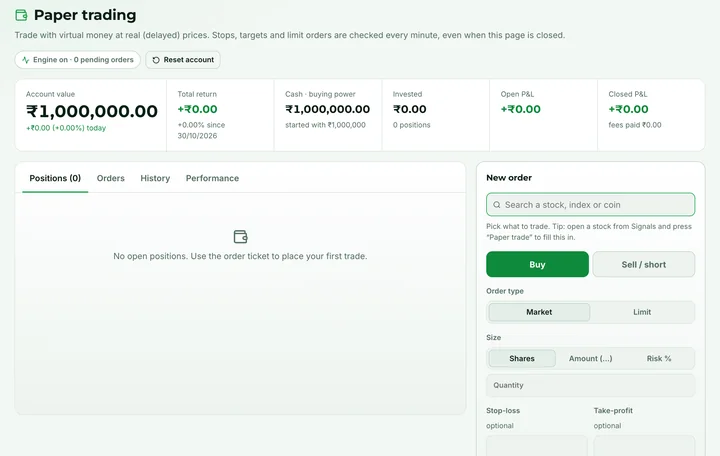
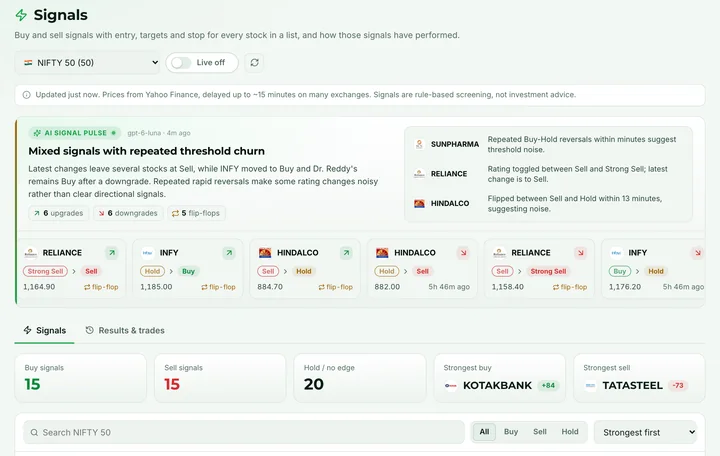

Market, limit and stop orders filled by a simulation model, with the assumed fill price and costs shown on each one.

Separate virtual accounts per strategy or experiment, so results never mix.

Simulated equity, returns and drawdowns over time, compared with the strategy's backtest.

A complete record of every simulated order, fill, cost and position change.

Invested versus cash, concentration by instrument and how close positions are to their limits.

Timestamped notes tied to trades and versions, so observations do not get lost.
Paper trading is more realistic than a backtest because the data is new, but it is still a simulation. These are the main gaps to keep in mind.
| Factor | In Studio paper trading | In live markets |
|---|---|---|
| Money at risk | None. Balances are virtual. | Real capital can be lost, including more than expected in fast markets. |
| Order routing | No broker connection. Orders are never sent anywhere. | Orders pass through a broker and an exchange, with their own rules and delays. |
| Fills | Estimated by a model using available prices. | Depend on the order book, queue position and other participants. |
| Slippage and spreads | Applied as assumptions you configure. | Vary with liquidity, volatility and order size, often unfavorably. |
| Partial fills and rejections | Simplified or not modeled. | Common for limit orders, thin markets and large sizes. |
| Your own behavior | No real pressure to override the strategy. | Losses with real money make it much harder to follow the rules. |

Product status: Quantzivo Studio is in development. Features described here reflect the planned scope and may change before release.

Only paper trade a version that survived costs, out-of-sample tests and sensitivity checks.
Backtesting
Write down the trade frequency, drawdown and behavior the backtest suggests you should see.

Let the strategy trade a virtual portfolio long enough to produce a meaningful number of trades.

Check paper results against your expectations, then revise, keep observing or retire the idea.
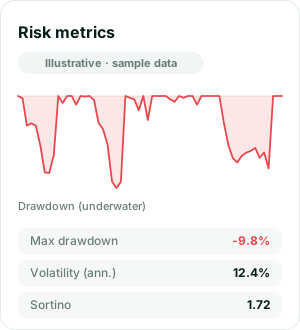
Returns arrive late; exposure is visible immediately. The paper trading dashboard is designed to show how much of each virtual portfolio is at work, where it is concentrated and how today's drawdown compares with the backtest's history.
 Invested, cash and gross exposure at a glanceConcentration by instrument against your position limitsCurrent drawdown compared with the backtested range
Memory is selective, especially about trades. Logs are designed to capture context at the moment it happens, linked to the trade and strategy version.

What the strategy is supposed to capture, written before the first simulated trade.

The exact strategy version, parameters and cost assumptions in use.
Where paper behavior differs from the backtest: more trades, larger losses, different timing.

Notable events or regime changes that may explain unusual results.

Changes you make and why, recorded before you see whether they help.

What the experiment taught you, even, and especially, when the answer is "this does not work".
Request early access to Quantzivo Studio and help us shape simulated paper trading, portfolio tracking and research logs.