


Learn Trading & Algorithmic Development with AI.
Develop practical financial market, coding, quantitative research, and AI skills through structured learning paths and hands-on projects.
Develop practical financial market, coding, quantitative research, and AI skills through structured learning paths and hands-on projects.
Markets today run on data and code. The Academy teaches both together: how instruments and order books behave, how to work with market data in Python, and how to test ideas without fooling yourself.
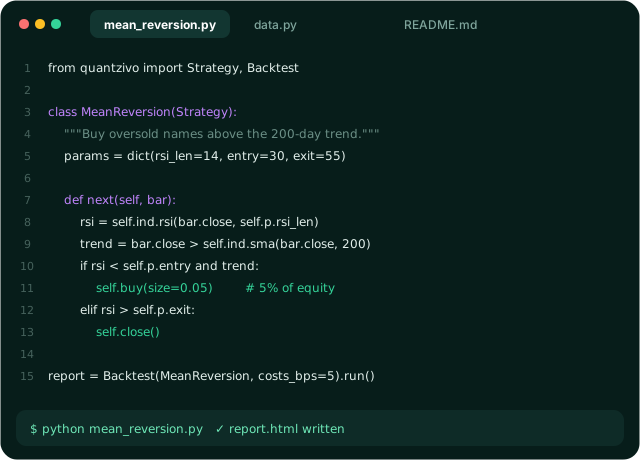


Clear levels so you always know what to learn next.

From first scripts to vectorized analysis with pandas and NumPy.

How exchanges, orders, data feeds and trading systems fit together.

Clean, align and analyze time-series data with confidence.

Apply ML and NLP to financial data with honest validation.

Turn ideas into explicit rules, parameters and risk controls.

Learn what backtests can and cannot tell you, and how to avoid bias.

Portfolio-ready projects that show what you can build.

Live sessions for questions, code reviews and deeper discussion.

Quizzes and project checks that confirm real understanding.

Recognition for completing a course and its assessed projects.

Programs designed for campuses and professional teams.
Whether you come from engineering, finance, data science or the trading desk, the Academy meets you where you are.

Add practical market and coding skills alongside your degree.
Apply programming and maths to financial systems.

Explore trading technology, data pipelines and research tools.

Pair financial theory with the code used to test it.
Move your engineering skills into fintech and quant work.

Learn the time-series and validation methods markets require.

Structured, flexible learning that fits around your job.

Systematise your process with code and testing.
50 courses across ten disciplines take you from market fundamentals to quantitative research, AI and FinTech engineering.

 5 weeks
 5 modules
Learn Python from the ground up through financial examples: core syntax, pandas time series, returns calculations, plotting and clean, testable code.

 6 weeks6 modules
Build a modular algorithmic trading research stack in Python, covering data handling, signal libraries, vectorized and event-based backtests, and paper-trading workflows.
 3 weeks3 modules
A structured introduction to how global equity, fixed income, currency and commodity markets are organized, who participates, and how prices and risk are communicated.
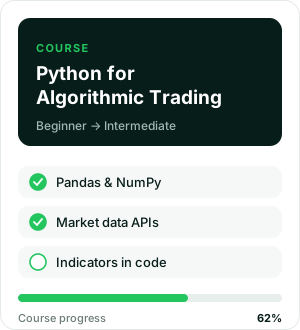
Every course combines short knowledge checks with assessed projects. Completing both earns a Quantzivo certificate of completion and leaves you with work you can show.
 Module quizzes to check understandingProject reviews against clear rubricsCertificates of completion for finished courses

Quantzivo certificates recognize course completion. They are not professional licenses, degrees or regulatory qualifications.
Tell us what you want to learn and we will share course schedules, formats and pricing as enrollment opens.

