


Market Sentiment Analysis, with the Caveats Built In.
Classify the tone of financial news, follow how it shifts across companies, sectors and events, and drill down to the articles behind every reading.
Classify the tone of financial news, follow how it shifts across companies, sectors and events, and drill down to the articles behind every reading.
Sentiment analysis uses natural language processing to label financial news as positive, negative, neutral or mixed, then aggregates those labels over time. Used carefully, it is a useful way to summarize large volumes of coverage. Used carelessly, it is easy to over-read.
 In development

Product status: Quantzivo AI is in development. Features described here reflect the planned scope and may change before release.
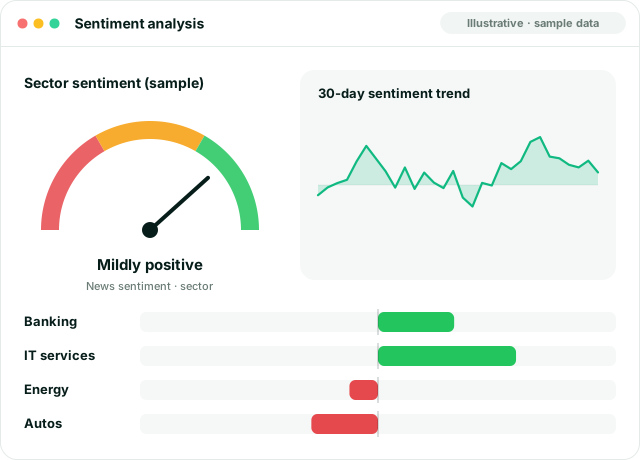


Tone labels for individual news items about the companies, sectors and topics you follow.

Positive, negative, neutral and mixed labels, each with a confidence level rather than false precision.

Rolling views of sentiment by company, sector or watchlist, shown together with the volume of coverage.

Compare coverage in a window before and after an event such as a results release or policy decision.

Look back over longer periods to see how the tone of coverage evolved through different market conditions.

Open any reading to see the individual stories, their labels and links to the original sources.

News items are gathered, de-duplicated and matched to the companies and sectors they discuss.
A language model labels each item's tone toward the subject it mentions and records how confident it is.

Labels are combined by company, sector and time window, with the number of articles shown beside each reading.

You can open the underlying articles to check whether the labels make sense in context.
Labels describe the tone of the text as written. They are not judgments about the company or forecasts of what will happen next.
| Label | What it means | Example phrasing (illustrative) |
|---|---|---|
| Positive | The text mainly reports favorable developments for the subject. | "Quarterly revenue rose on stronger demand and the company maintained its outlook." |
| Negative | The text mainly reports unfavorable developments for the subject. | "The company lowered its full-year guidance, citing weaker orders." |
| Neutral | The text is factual or procedural, with no clear favorable or unfavorable angle. | "The board will meet next week to consider the annual accounts." |
| Mixed | The text contains significant favorable and unfavorable points. | "Profit beat last year's level, but margins narrowed as costs increased." |
Every sentiment model makes mistakes. Knowing the typical failure modes helps you decide how much weight a reading deserves.

Commentary that says one thing and means another is often labeled by its literal words.

"Results were broadly in line" can read as positive or negative depending on what was expected.

Words like "cut", "beat" or "exposure" change meaning by context: a rate cut and job cuts are not the same story.

A reading based on a handful of articles can swing sharply. Always check the article count.
The same story syndicated many times can dominate an aggregate unless duplicates are grouped.

Positive coverage does not mean prices will rise. Markets often react to news relative to expectations.

Sentiment is not a trading signal. Sentiment readings describe the tone of published coverage. They do not predict price direction and are not buy or sell recommendations.
Compare the tone and volume of coverage in the weeks before and after a company reports, then read the stories that drove any shift.
Track how coverage of a rate-sensitive sector changed as central bank policy shifted, alongside the macro data for the same period.
Put several companies in the same industry side by side to see whether one is attracting noticeably different coverage, and why.
Request early access to the sentiment module, or learn the NLP and validation methods behind it in Quantzivo Academy.
 Macro Intelligence
 Backtesting